
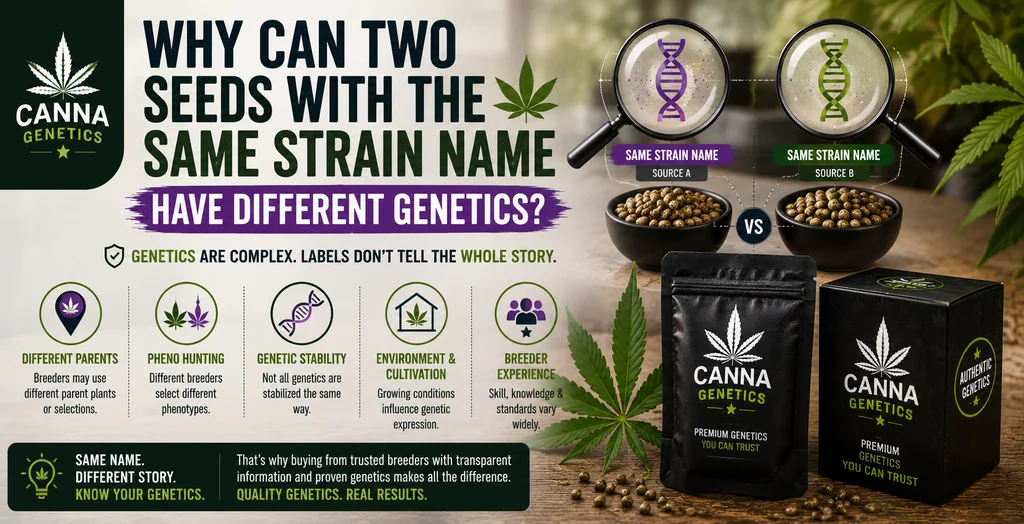
Buy two packets labelled “Gorilla Glue” from two sellers, and you may end up with two genetically different plants. This is a structural feature of the cannabis seed market, not a quality-control failure. Understanding this starts with a basic grasp of authentic cannabis genetics, from how breeders classify lineage to what causes two “identical” strains to grow and perform differently. Strain names are not patented or tied to a certified standard, unlike a protected agricultural cultivar such as Honeycrisp apples. Anyone can breed a plant, attach a well-known name to it, and sell the result.
The more collectors understand how authentic cannabis genetics actually works, the easier it becomes to separate a strain built on real breeding history from one that simply borrows a familiar label.
Genotype vs Phenotype
- Genotype is a plant’s full genetic code, inherited from its parents.
- Phenotype is how that code is expressed: height, colour, aroma, resin, and growth pattern in a given environment.
Two plants can share a similar genotype and still produce different phenotypes, since expression is shaped by light, nutrients, and climate too. This distinction sits at the foundation of authentic cannabis genetics because a strain name usually claims a genotype, while what you actually observe is a phenotype.
Without understanding this gap, it is easy to assume that any plant carrying a familiar name must be genetically identical to the original, which is rarely the case.
Four Reasons a Name Can Hide a Different Genetic Story
The gap behind genuinely authentic cannabis genetics usually comes down to four factors, each rooted in how cannabis reproduces and how the seed trade actually operates.
1. Independent breeding attempts
When a strain becomes popular, other breeders offer something under the same name, usually without access to the original elite clone. They cross plants they believe match the original lines, or introduce different genetics for yield or resistance while keeping the recognisable name for marketing.
2. Natural phenotypic variation between siblings
Seeds from the same pod are not genetically identical, since reproduction reshuffles genetic material each time. Like human siblings sharing parents but differing in appearance, one seed might grow tall and citrus-forward while its sibling stays short and earthy.
3. Instability in early filial generations
Breeders stabilise a strain through backcrossing, breeding offspring with a parent line across generations until traits are reproduced reliably. Many commercial batches are F1 or F2 hybrids, which carry wide genetic diversity and can vary noticeably from plant to plant even within the same pack.
4. Polyhybridisation and genetic drift
Most cannabis today is already a multi-hybrid cross. Small mutations can accumulate across generations, called genetic drift, shifting a line away from its documented origin over time, sometimes without any breeder intending the change at all.
Landrace Genetics: A Genetic Anchor Point
Landrace strains developed naturally in a region without deliberate crossbreeding; examples include Afghani indica lines and Thai sativas. Because they were never engineered, they act as the reference points that later hybrids are measured against, and they remain some of the clearest markers of authentic cannabis genetics available to collectors today. A landrace line that has been carefully preserved across decades gives breeders a stable genetic anchor to work from, which is part of why so many modern hybrids can still be traced back to a handful of well-documented regional origins.
Comparing Seed Types by Genetic Reliability
| Seed Type | Genetic Consistency | Typical Use Case | Notes |
| Landrace | Highest, if properly sourced | Preservation, breeding stock | Narrow, documented origin |
| Stabilised feminised | High | Predictable collector traits | Multiple backcrossed generations |
| F1 hybrid | Moderate | Novel trait combinations | More variable |
| F2 hybrid or later | Lower | Experimental lines | Wider genetic spread |
| Autoflowering | High for timing/structure | Fast, compact cycles | Ruderalis genetics drive flowering |
What Are the Best Types of Cannabis Seeds for Verified Genetics?
Collectors often ask what the best types of cannabis seeds are when lineage accuracy matters more than novelty. Stabilised feminised lines and documented landrace genetics tend to offer the most reliable answer, since both come with a traceable breeding history rather than a guess.
Autoflowering lines can also be dependable for structure and timing, provided the breeder has done the stabilisation work behind the label, rather than simply crossing ruderalis genetics into an existing line without further testing.
Industry Trends in Cannabis Genetics
Interest in verified genetics has grown alongside wider legal and medical developments across markets. Breeders increasingly focus on cannabinoid and terpene profiling and genetic marker testing, work that mirrors cultivar verification used elsewhere in agriculture. As regulation evolves, seed provenance and fast shipping of cannabis seeds are both becoming part of how the industry signals quality, pairing verifiable lineage with a properly run operation from breeding through to dispatch.
How Breeders Stabilise Genetics
Achieving authentic cannabis genetics is not a marketing claim; it is a process that unfolds over multiple growing seasons.
- Selecting parent plants with consistent traits across multiple grow cycles.
- Backcrossing offspring with a stable parent line over several generations.
- Testing structure, aroma, and cannabinoid expression before commercial release.
- Keeping breeding records so lineage claims can be verified, not assumed.
How to Evaluate a Strain’s Genetic Claims
- Check for specific parent genetics rather than vague marketing language.
- Compare the described phenotype traits against what is documented for that lineage.
- Look for breeder history, award recognition, or clear sourcing explanations.
- Be cautious of listings using a famous name with no supporting background.
Following this checklist is the most reliable way to confirm authentic genetics before adding a strain to your catalogue.
Key Takeaways
- Strain names are unregulated, so identical names can hide different genetics.
- Genotype is the code; phenotype is its expression, and the two do not always match a name’s promise.
- Instability usually comes from rebreeding, sibling variation, early filial generations, and polyhybrid drift.
- Landrace genetics offers the clearest reference point for verifying origin.
- Breeder documentation matters more than a familiar name.
Where to Go From Here
Building a collection around authentic cannabis genetics takes more effort than picking a familiar name off a list, but it is the only way to know what you are actually adding to a catalogue. Canna Genetics documents parent lineage and checks genetic stability before any strain joins the current collection, backed by fast shipping of cannabis seeds across the UK and full breeding notes on individual strain pages.
Two examples of names with several documented versions are Gorilla Glue and Wedding Cake; each Canna Genetics listing states the reported lineage it is working from. See also what to look for in cannabis seeds for sale in the UK.
Frequently Asked Questions
Its genotype, inherited at pollination, is expressed as a phenotype shaped by growing conditions.
Indica describes structure and general terpene tendencies, not identical effects. Cannabinoid ratios and terpene profiles vary between lines even within the same category.
Through repeated backcrossing across generations while selecting for the traits they want to lock in, a process that can take years.
Cannabis populations that developed naturally in a region without deliberate crossbreeding, valued as an unmixed genetic starting point for later hybrids.
Terpenes shape smell and flavour and are believed to interact with cannabinoids to influence the overall effect. Since terpene profiles vary by phenotype, they help reveal whether two same-named seeds actually share genetics.
